


You can save thousands of dollars on a home by negotiating well. Most sellers expect an offer below the asking price, and buyers who prepare well almost always do better than buyers who don’t. This guide gives you the exact steps, scripts, and mindset you need.
Negotiating a house price isn’t about being aggressive. It’s about knowing the market, understanding the seller’s situation, and making smart moves at the right time. A calm, well-informed buyer usually beats an emotional one.
This article walks you through every stage of the negotiation, from your first offer to the final walkthrough. You’ll also find real scripts you can use and mistakes to avoid.
Research the Market Before You Make an Offer
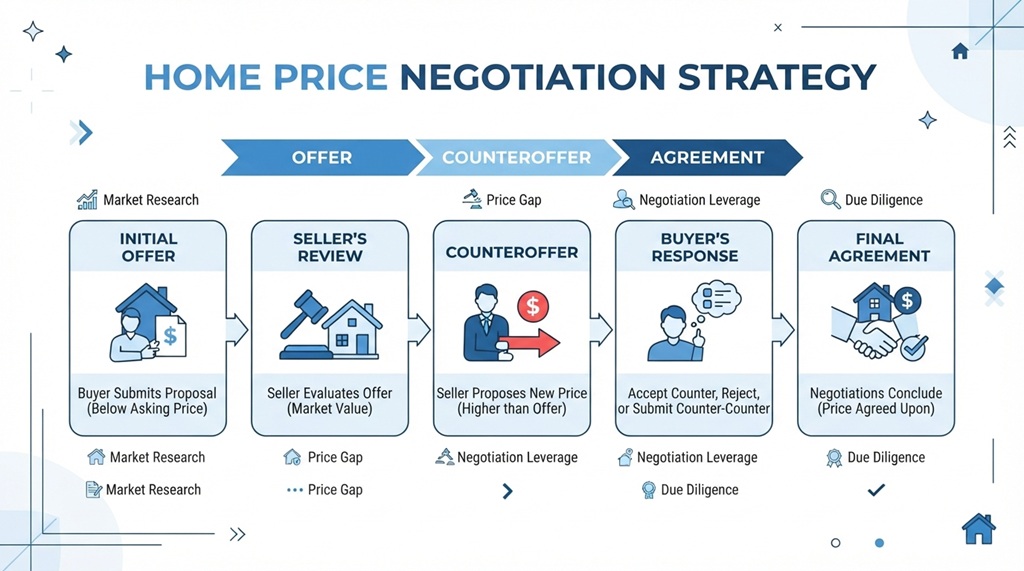
You need solid data before you negotiate anything. Without it, you’re just guessing, and sellers can tell.
Check Comparable Sales (Comps)
Look at homes similar in size, condition, and location that sold in the last three to six months. Your agent can pull this data from the MLS, or you can check public sites like Zillow or Redfin. Comps tell you what buyers actually paid, not what sellers hope to get.
Find Out How Long the Home Has Been Listed
A home sitting on the market for 60+ days signals a motivated seller. A home listed three days ago, with multiple showings already booked, gives you far less room to negotiate. Ask your agent for the “days on market” number and the listing history, including any past price cuts.
Leverage Local Market Conditions to Master Your Position
Understanding whether you are competing in a buyer’s or seller’s market directly dictates your pricing strategy: high inventory gives you significant leverage to request concessions, whereas low-inventory environments require surgical precision to avoid losing the property entirely. Aligning with an expert who reads neighborhood dynamics correctly ensures you bid with maximum impact; before entering contract discussions, find a good real estate agent you can trust who can negotiate effectively on your behalf.
Get Your Finances in Order First
Sellers take offers more seriously when they come from prepared buyers. This step alone can shift the whole negotiation in your favor.
Get a full mortgage pre-approval, not just a pre-qualification letter. Pre-approval means a lender has verified your income, credit, and assets, and it shows the seller you’re a serious, capable buyer. A pre-qualification is just an estimate and carries far less weight.
If you can offer a larger down payment or a flexible closing date, mention it in your offer letter. Sellers often value certainty and speed as much as price. A slightly lower offer with fewer conditions can beat a higher offer full of contingencies.
Learn the Seller’s Motivation
Knowing why someone is selling changes how you negotiate. This single insight often matters more than any pricing formula.
Ask your agent to find out details through the listing agent: Is the seller relocating for a job? Going through a divorce? Already bought another home and carrying two mortgages? Sellers under time pressure will often accept a lower price for a fast, clean closing.
You can also read between the lines. A vacant home suggests the seller has already moved and wants to close quickly. A price reduction shortly after listing suggests the seller is anxious about time on market. Staged, well-maintained listings with no price cuts usually mean less urgency and less room to negotiate.
Make a Strong but Smart First Offer
Your opening offer sets the tone for everything that follows. Go too low and you risk offending the seller; go too high and you leave money on the table.
Base Your Offer on Data, Not Emotion
Use your comps to justify your number. If similar homes sold for 3-5% below asking, structure your offer around that same range, then adjust based on the home’s condition and how long it’s been listed.
Include an Offer Letter With Reasoning, Not Just Emotion
Some buyers write personal letters about falling in love with the kitchen. These rarely move a seller focused on money. Instead, if you write a letter, explain your reasoning briefly and professionally: your pre-approval status, your flexible timeline, and your genuine interest in a quick, smooth transaction.
A Sample Opening Script
Here’s language your agent can use when submitting your offer: “We’ve reviewed recent comparable sales in the area and believe [offer amount] reflects fair market value, factoring in [specific condition issue, like an older roof or outdated systems]. Our buyers are pre-approved and can close within [X] days.”
Use Inspection Findings as Leverage

A home inspection often reveals real issues you can use to negotiate the price down, even after your offer is accepted.
If the inspector finds problems, like an aging HVAC system, roof damage, or plumbing issues, get repair estimates from a licensed contractor. Then present these numbers to the seller and request either a price reduction or a credit at closing. Sellers often prefer a credit because it avoids the hassle of managing repairs themselves before closing.
Don’t nickel-and-dime every minor cosmetic flaw, though. Focus on real, costly issues. Sellers respond better to a short list of major, well-documented problems than a long list of small complaints, which can make you seem difficult to work with.
Know When and How to Walk Away
Your strongest negotiating tool is your willingness to walk away. Buyers who need a specific house lose leverage the moment the seller senses it.
Set a maximum price before you start negotiating, based on your budget and the comps, and stick to it. If the seller won’t move close to that number, be ready to pass. Emotional attachment to a specific house is exactly what sellers and their agents count on when they hold firm on price.
That said, don’t threaten to walk away as a bluff unless you mean it. Experienced listing agents can often tell when a buyer is bluffing, and calling that bluff can cost you the deal entirely.
Common Mistakes That Cost Buyers Money
Even well-intentioned buyers lose negotiating power through avoidable errors.
- Skipping pre-approval: Sellers take unverified buyers less seriously and may reject their offers outright.
- Making a lowball offer without data: An offer far below market value, with no justification, often gets ignored rather than countered.
- Negotiating every small detail: Fighting over minor repairs after agreeing on price can sour the relationship and slow the deal.
- Revealing your maximum budget: Telling your agent your true ceiling in front of the listing agent removes your leverage instantly.
- Ignoring the closing timeline: Sellers sometimes value a fast, flexible closing date more than a slightly higher price.
Frequently Asked Questions
How much below asking price should I offer?
It depends on your market and the specific home. In a buyer’s market, 5-10% below asking is common; in a hot seller’s market, offering below asking may not work at all. Base your number on recent comps, not a fixed percentage rule.
Can I negotiate the price after the home inspection?
Yes, this is one of the most effective negotiation points. If the inspection reveals real issues, you can request a price reduction, a repair credit, or ask the seller to fix the problems before closing.
Is it rude to negotiate hard on a house?
No, negotiating is a normal, expected part of buying a home. As long as your offer is backed by data and delivered professionally, sellers and their agents won’t take it personally.
Should I use the same agent as the seller?
Using a separate buyer’s agent gives you dedicated representation focused on your interests alone. A dual agent, representing both sides, may have less room to advocate aggressively for your price.
What if the seller rejects my offer completely?
A flat rejection doesn’t always mean the deal is dead. Ask your agent to find out why, then consider a revised offer that addresses the seller’s main concern, whether it’s price, timeline, or contingencies.
Conclusion
Negotiating a house price comes down to preparation, not aggression. Research the comps, understand the seller’s motivation, get your financing ready, and use inspection findings as real leverage when they arise. Buyers who follow these steps consistently save thousands of dollars, and they do it without burning bridges or losing the home they want.